Binaural Beats for Anxiety, Sleep, and Focus: What the Science Really Says
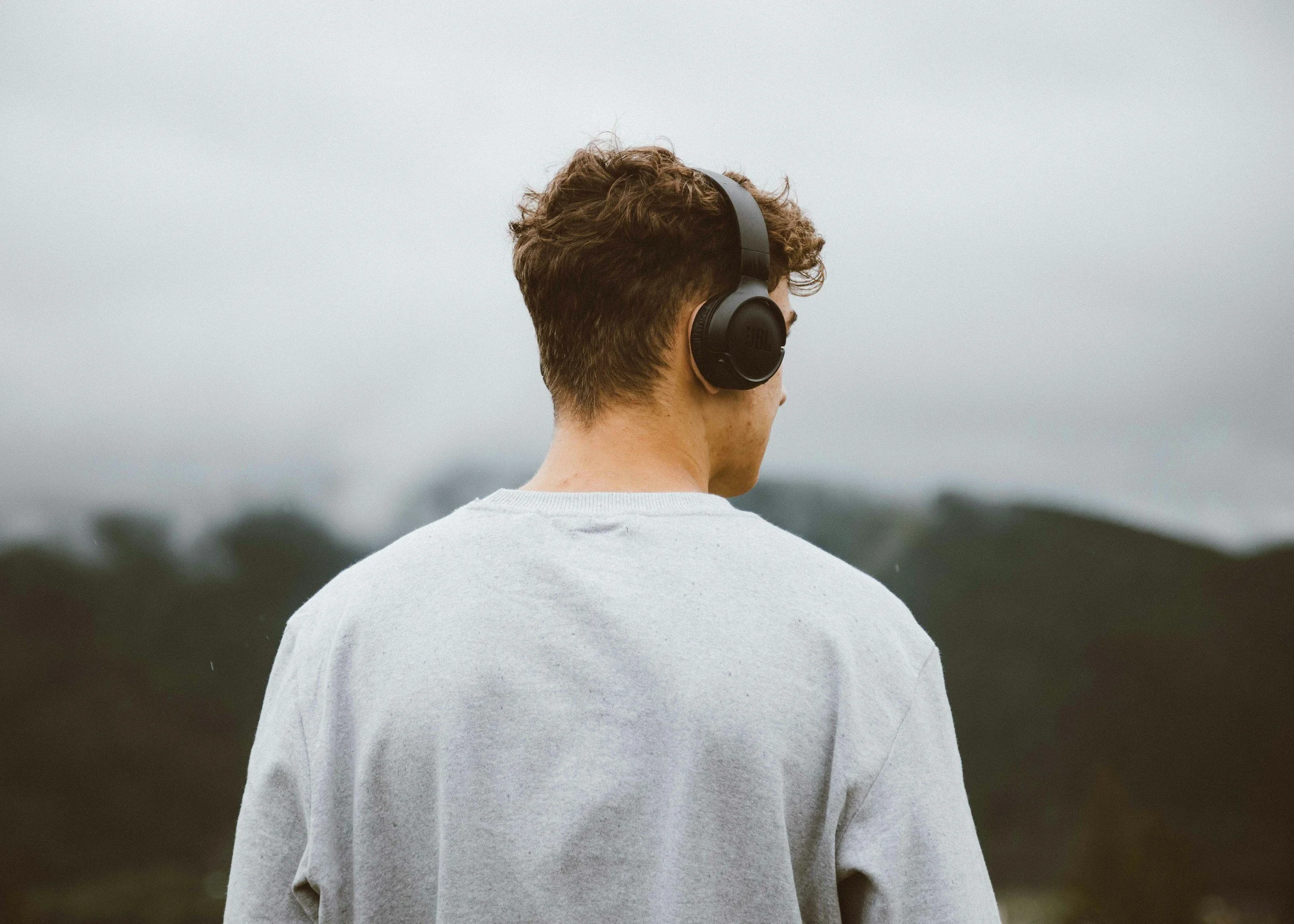
It is 10:47 p.m. Your body is exhausted, but your brain has decided this is the perfect moment to replay a conversation from 2014, draft tomorrow's emails, and wonder whether you left the garage open. You grab your phone, search "sounds to fall asleep," and land on an eight-hour video promising to "reprogram your brainwaves in minutes."
As a psychologist and anxiety therapist in Greenville, SC, I hear some version of this story almost every week. Plenty of people have tried binaural beats. Some swear by them. Others shrug. Most want a straight answer: Is this real, or is it the wellness version of a mood ring?
The honest answer sits in the middle, and that middle is more useful than the hype. Binaural beats have modest but real research support for easing anxiety, and much weaker support for the bigger claims. Used wisely, they can be a helpful daily habit, which is why I built sound sessions into my iOS app, WaveMind Pro. Below I'll cover how binaural beats work, what the studies show, and a practical protocol you can start tonight.
A quick note: any client stories below are composites, with details changed to protect confidentiality.
Why Sound Matters for Anxiety, Sleep, and Focus
Before I was a psychologist, I was a veteran and later a VA Police Officer. In both jobs, I learned something about the nervous system that no textbook put quite so bluntly. The body often decides you are in danger before your thinking brain gets a vote. A racing heart, shallow breathing, tight shoulders, and a mind that won't stop scanning are not character flaws. They are an alarm system doing its job a little too well.
Many of my clients, including veterans, first responders, and adults who have carried anxiety for years, share one frustration: "I know I'm safe, but my body doesn't believe me." Therapy approaches like CBT, DBT, and EMDR change the relationship with those alarm signals. But people also need tools they can use at 10:47 p.m. or before a hard meeting. That's where "bottom-up" tools like breathing, movement, and sound come in. Lullabies, drumming, and white noise machines all rely on the same idea: rhythm and tone shift how settled we feel. Binaural beats are a modern, more precise version.
How Binaural Beats Work
Two tones, one "phantom" beat
Here is the basic setup. Your left ear hears one steady tone, for example 200 Hz. Your right ear hears a slightly different tone, say 210 Hz. Neither tone contains a "beat." Yet your brain perceives a gentle, pulsing wobble at the difference between them. In this case, that is 10 pulses per second (10 Hz).
That wobble isn't in the air. It is created inside your auditory system, where signals from both ears come together in the brainstem. The biophysicist Gerald Oster brought this phenomenon to wide attention in his 1973 Scientific American article, "Auditory Beats in the Brain." He described binaural beats as a window into how the brain combines sound from the two ears, and he suggested possible uses in research and clinical settings (Oster, 1973).
Why you absolutely need stereo headphones
Because the effect depends on each ear getting its own tone, binaural beats require stereo headphones or earbuds. Play them through a phone speaker or a Bluetooth speaker in the kitchen and the two tones mix in the air before they reach you. At that point you are listening to a pleasant hum, not a binaural beat.
If you have teenagers, they are world-class headphone experts. The eye-roll you get when you announce, "I'm doing my brainwave session now," is free of charge, and so is the irony.
A few practical notes:
- Over-ear or in-ear both work, as long as "mono audio" is turned off.
- Noise-canceling helps in loud places but isn't required.
- Keep volume comfortable and low. Binaural beats work at quiet volumes. Loud is not "stronger." It is just loud.
The brainwave vocabulary
You'll see binaural beat programs labeled by EEG frequency bands, the same bands I look at in qEEG brain mapping:
- Delta (about 0.5 to 4 Hz): deep sleep
- Theta (about 4 to 8 Hz): drowsiness, deep relaxation
- Alpha (about 8 to 12 Hz): calm, relaxed wakefulness
- Beta (about 13 to 30 Hz): active thinking and focus; at higher levels, worry
- Gamma (about 30 Hz and up): linked in research to attention
These labels are useful shorthand, not switches in your head.
The frequency-following (entrainment) hypothesis
The popular explanation is brainwave entrainment, or the frequency-following response: if your brain perceives a 10 Hz beat long enough, its electrical rhythms will "follow" and drift toward 10 Hz alpha. The same logic underlies theta beats for relaxation, delta for sleep, and beta or gamma for focus.
It is an elegant hypothesis. It is also, at this point, not well established. And that is exactly where honesty matters.
What the Research Actually Shows
My job isn't to sell clients a technique; it's to help them decide with the best available evidence. Here's the plain-language tour, including the parts that don't make exciting social media posts.
The encouraging news: small-to-moderate effects on anxiety
The most-cited summary is a meta-analysis by Garcia-Argibay, Santed, and Reales (2019) published in Psychological Research. They pooled 22 studies (35 effect sizes) on binaural beats and cognition, anxiety, and pain. The overall effect was medium in size (g = 0.45), and several findings stand out:
- Anxiety went down after binaural beat exposure, especially in studies using theta-range beats.
- Pain-related outcomes improved in some procedural studies, including reduced need for pain medication.
- Attention results were more positive in some studies using higher (gamma) frequencies. Memory results were mixed and depended on the frequency used.
- Listening before a task, or before and during it, tended to work better than listening only during the task. Longer exposure also seemed more effective than very brief exposure.
That timing finding shapes the protocol I share below.
A 2015 review in Frontiers in Psychiatry by Chaieb and colleagues reached a similar, cautious conclusion. Anxiety reduction was one of the more consistent findings across studies. Effects on memory, attention, and vigilance were contradictory, and varied methods made firm conclusions difficult (Chaieb et al., 2015).
A real-world example: the surgery waiting room
One of the better-known clinical studies comes from a hospital setting. Padmanabhan, Hildreth, and Laws (2005) randomized patients awaiting day-case surgery under general anesthesia into three groups: binaural beat audio, the same kind of audio without the binaural beats, or no audio. Anxiety dropped by about 26% in the binaural beat group, compared with about 11% in the audio-only group and about 4% with no intervention.
Because the comparison group also got relaxing audio, the extra benefit can't be explained only by "headphones plus nice sounds." That doesn't prove entrainment, but the beats may add something for acute, situational anxiety.
Small studies, big caveats
Many binaural beat studies are small. A pilot study by Wahbeh, Calabrese, and Zwickey (2007) followed eight healthy adults who listened to delta-frequency binaural beats daily for 60 days. They reported lower trait anxiety and better quality of life. That is interesting. It is also eight people, with no control group. The authors themselves called for larger controlled trials. I'd call it a promising "hmm," not a verdict.
That pattern runs through the field: small samples, varied frequencies and session lengths, and few large, well-controlled trials.
The mixed news: does your brain actually "entrain"?
Here is the part the eight-hour video left out. In 2023, Ingendoh, Posny, and Heine published a systematic review in PLOS ONE that looked specifically at whether binaural beats change brain oscillations measured by EEG. They found 14 studies. Five supported the entrainment hypothesis, eight contradicted it, and one had mixed results. Their bottom line is worth quoting:
"The methodological heterogeneity in this field of study ultimately limits the comparability of research outcomes." (Ingendoh et al., 2023)
In plain English: researchers have used so many different methods that we can't yet say with confidence whether binaural beats reliably push your brainwaves toward a target frequency.
How I put it all together as a clinician
So where does that leave us? Here is my honest synthesis:
- Binaural beats appear to help some people feel less anxious, with small-to-moderate effects on average.
- The strongest support is for short-term, situational anxiety (like a pre-surgery waiting room), more than for long-term cures of anything.
- Evidence for improved focus, memory, and sleep is mixed and still emerging.
- We don't know for sure that the mechanism is brainwave entrainment. Benefits might come partly from focused listening, expectation, a relaxing ritual, reduced outside noise, or simply giving yourself 15 minutes of permission to stop.
- None of that makes it useless. A low-cost, low-risk tool with a modest benefit can be very worthwhile, if you use it as one part of a bigger plan.
That last point is the heart of how I designed WaveMind Pro.
How WaveMind Pro Uses Sound as Daily Brain Training
I created WaveMind Pro to give people something between "random YouTube video" and "weekly session in my office." It's built around a few core experiences:
- Binaural and sound sessions for relaxing, winding down, or getting ready to focus.
- Immersive visual and audio sessions that pair sound with visuals, for people who settle more easily when their eyes have somewhere calm to rest.
- Neurofeedback training with a BrainBit EEG headband, which lets your actual brain activity guide the session rather than just playing sound at you.
- Mind Tree, a focus game designed to make attention practice feel less like homework.
Why I think of it as "training," not "treatment"
I want to be very clear: WaveMind Pro is a supportive wellness tool. It is not a replacement for therapy, psychiatric care, or medical treatment. It doesn't diagnose anything, and it isn't a cure for anxiety, insomnia, ADHD, PTSD, or anything else.
What it can be is a daily practice, like a walk or a stretching routine, that teaches your nervous system something valuable: there is a reliable way to come down from high alert.
Where neurofeedback adds something sound alone can't
Binaural beats are passive: sound goes in, and we hope the brain responds. Neurofeedback is active: sensors read your brain activity, the session responds, and your brain gradually learns to spend more time in the targeted pattern.
In my office at BrainFit Studio, I use qEEG brain mapping and BrainPaint neurofeedback. For remote clients, I use the BrainBit headband. The neurofeedback training in WaveMind Pro grows out of that same philosophy. It's a practical, at-home way to practice. It is not a clinical qEEG assessment, and it doesn't replace working with a trained provider. If you're curious about full brain mapping or in-office neurofeedback in Greenville, SC, that's a conversation worth having in person.
Clients often ask: "I'm on sertraline (or Xanax, Adderall, a sleep aid, cannabis, or nightly wine). Does that change my brainwaves?" Often, yes. Benzodiazepines tend to increase beta activity. Stimulants can reduce slower theta activity. Cannabis and alcohol can shift alpha and theta. We don't ask people to stop prescribed medications to get a "clean" brain map. Never stop or change a medication without talking to your prescriber. Instead, we document everything, interpret the results in context, and re-measure under consistent conditions. The same common-sense rule applies at home: if your readings look different on a night you had two drinks, that's information, not failure.
A composite client story
"Dana" (a composite) is a nurse from Mauldin who came to me for anxiety and poor sleep after a string of brutal hospital shifts. Her mind raced every night, and she'd started scrolling until 1 a.m. to avoid lying in the dark with her thoughts.
In therapy, we worked on the trauma memories driving her hypervigilance. We also built a nightly routine: phone on "do not disturb," lights low, and a 20-minute wind-down sound session. She didn't call it magic. She said, "It gives my brain a place to go that isn't my inbox." After several weeks, she was falling asleep earlier most nights. Sound didn't do the healing alone, but it gave her a consistent on-ramp to rest.
A Practical Binaural Beat Protocol: Timing and "Dose"
Research hasn't settled on one perfect frequency or session length. So think of what follows as a reasonable starting framework from a clinician, not a prescription. It draws on the finding that pre-task and longer exposure seem to work better (Garcia-Argibay et al., 2019). It also reflects what I've seen clients actually stick with.
Before you start: the ground rules
- Stereo headphones, every time.
- Comfortable, low volume. If someone across the room can hear it, turn it down.
- Sit or lie down. Never listen while driving, operating machinery, or doing anything that requires full alertness.
- Track it simply. Rate your anxiety or sleepiness from 0 to 10 before and after. After two weeks, you'll have your own data instead of guesses.
Protocol 1: The Evening Wind-Down (for sleep and nighttime anxiety)
- When: 30 to 60 minutes before your target bedtime, or once you're in bed.
- Dose: 20 to 30 minutes.
- Sound style: slower, relaxation-oriented sessions (typically theta-range, drifting toward delta for sleep).
- Pair it with: dim lights, phone in do-not-disturb mode, slow breathing (try breathing out longer than you breathe in).
- Frequency: nightly for at least two weeks before you judge whether it helps.
Protocol 2: The Pre-Work Focus Session
- When: right before a focused work block, studying, or a demanding task, not in the middle of it.
- Dose: 10 to 20 minutes.
- Sound style: focus-oriented sessions (often alpha for calm focus, or beta/gamma-labeled sessions). Remember, evidence here is mixed.
- Pair it with: a written "one thing" goal for the next work block. Follow with a few minutes of Mind Tree if you like to warm up your attention with a game.
- Frequency: workdays, or before your hardest task of the day.
Protocol 3: The Anxious-Moment Reset
- When: before a stressful event (a medical appointment, a presentation, a hard conversation) or when anxiety spikes.
- Dose: 5 to 15 minutes. Even 3 to 5 minutes can help as a pattern interrupt, though the research suggests longer is better when you have the time.
- Sound style: calming, relaxation-oriented sessions.
- Pair it with: a grounding skill, such as naming five things you see, feeling your feet on the floor, or slow exhales.
- Frequency: as needed. But if you are "resetting" many times a day, that's a signal to reach out for more support, not just more listening.
Start small. Consistency beats intensity. A 15-minute session you actually do five nights a week is worth far more than a heroic 90-minute session you do once and then abandon.
Safety First: Who Should Be Careful
Binaural beats are generally considered low-risk, but "low-risk" isn't "no-risk." Please keep these points in mind:
- Never use while driving or doing anything that requires your full attention. Relaxation sessions can make you drowsy, which is the point at bedtime and a hazard behind the wheel.
- Seizure disorders: If you have epilepsy or a history of seizures, talk with your neurologist before using rhythmic audio. Be especially careful with immersive visual sessions, since flashing or flickering visuals can trigger seizures in people with photosensitive epilepsy.
- Hearing: Keep volume low, and check with your physician if you have tinnitus or a hearing condition.
- Mental health and medical conditions: If you have PTSD, a dissociative disorder, bipolar disorder, or psychosis, or you are pregnant, have an implanted device, or are setting this up for a child, talk with your provider first. Deep relaxation can occasionally stir up unexpected memories or feelings.
- Don't swap sound for care. If sleep problems or anxiety last more than a few weeks or interfere with daily life, see a professional.
Action Steps: Start Tonight
- Grab real stereo headphones and confirm mono audio is off.
- Pick one goal (sleep, focus, or anxious moments).
- Choose the matching protocol and put it in your calendar.
- Rate yourself 0 to 10 before and after each session for 14 days.
- Try a structured tool like WaveMind Pro.
- Review your data after two weeks. Keep what helps; adjust what doesn't.
- Bring your results to your therapist or provider, especially if you take medications or live with trauma, chronic insomnia, or persistent anxiety.
Finding Sleep and Anxiety Help in the Upstate, SC
Anxiety and sleep problems usually have deeper roots: trauma, chronic stress, relationship strain, or long-running thought patterns. The best results typically combine skills you practice at home with professional care that addresses the "why." I offer counseling in Simpsonville, SC in person and telehealth across South Carolina (and California), working with clients from Greenville, Mauldin, Fountain Inn, Five Forks, Greer, and Spartanburg. Learn more at Your Kind of Happy LLC.
Frequently Asked Questions
How do I find an anxiety therapist in Greenville, SC?
Look for a licensed mental health professional who uses evidence-based approaches such as CBT, DBT, or EMDR and has experience with your specific concerns (trauma, panic, sleep, etc.). Check insurance options and whether telehealth is offered. Dr. Matt McKeithan sees clients in person in Simpsonville and via telehealth across South Carolina. Call (864) 400-1469 or visit yourkindofhappy.org.
Do binaural beats really work for anxiety?
Research suggests binaural beats can produce small-to-moderate reductions in anxiety for some people, especially for short-term or situational anxiety (Garcia-Argibay et al., 2019; Padmanabhan et al., 2005). They're not a cure, and results vary. They work best as one part of a broader plan.
Can binaural beats help me sleep?
Some people find relaxation-focused sessions helpful as part of a bedtime routine, but the sleep-specific research is limited and mixed. For ongoing insomnia, talk with a provider about evidence-based options such as cognitive behavioral therapy for insomnia (CBT-I).
Where can I get sleep and anxiety help or neurofeedback in the Upstate, SC?
Start with your primary care provider to rule out medical causes, then look for a psychologist who treats both anxiety and sleep. Dr. Matt offers counseling in Simpsonville, statewide telehealth, and qEEG and neurofeedback through BrainFit Studio. Neurofeedback research is promising for some conditions and still developing for others.
Do I need headphones for binaural beats?
Yes. Binaural beats depend on each ear hearing a slightly different tone, so you need stereo headphones or earbuds. Speakers mix the tones before they reach your ears.
Conclusion: Sound Is a Tool, and You Are the One Training
Binaural beats won't rewire your brain overnight, and anyone promising that is selling something. But current research suggests they can modestly ease anxiety for many people, give a racing mind a place to land, and turn "I should really relax" into a repeatable habit.
The bigger takeaway: your nervous system can learn. Every 15 minutes you give your brain to settle is practice. Pair it with honest tracking, good sleep habits, and professional support when needed, and you're building something more durable than any single app.
So tonight, let the teenagers roll their eyes. Put on the headphones anyway.
Ready for More Support? Anxiety Therapy in Greenville and Simpsonville, SC
If anxiety, poor sleep, or trauma is getting in the way, you don't have to figure it out alone. As an anxiety therapist serving Greenville, SC and the Upstate, I offer in-person counseling in Simpsonville and telehealth across South Carolina and California. I accept Aetna, United/Optum (SC and CA), and BCBS (CA), and provide superbills for out-of-network clients.
- Therapy and counseling: Your Kind of Happy LLC
- qEEG brain mapping and neurofeedback: BrainFit Studio
- Daily brain training at home: WaveMind Pro on the App Store
- Call: (864) 400-1469
Educational disclaimer: This article is for general educational purposes only and is not a substitute for individualized medical or mental health care. Binaural beats, apps, and neurofeedback are not guaranteed to work for everyone and are not replacements for professional diagnosis or treatment. Do not stop or change medications without talking to your prescriber. If you are in crisis or thinking about harming yourself, call or text 988 (Suicide & Crisis Lifeline) or call 911.
References
Chaieb, L., Wilpert, E. C., Reber, T. P., & Fell, J. (2015). Auditory beat stimulation and its effects on cognition and mood states. Frontiers in Psychiatry, 6, Article 70. https://doi.org/10.3389/fpsyt.2015.00070
Garcia-Argibay, M., Santed, M. A., & Reales, J. M. (2019). Efficacy of binaural auditory beats in cognition, anxiety, and pain perception: A meta-analysis. Psychological Research, 83(2), 357–372. https://doi.org/10.1007/s00426-018-1066-8
Ingendoh, R. M., Posny, E. S., & Heine, A. (2023). Binaural beats to entrain the brain? A systematic review of the effects of binaural beat stimulation on brain oscillatory activity, and the implications for psychological research and intervention. PLOS ONE, 18(5), Article e0286023. https://doi.org/10.1371/journal.pone.0286023
Oster, G. (1973). Auditory beats in the brain. Scientific American, 229(4), 94–102. https://doi.org/10.1038/scientificamerican1073-94
Padmanabhan, R., Hildreth, A. J., & Laws, D. (2005). A prospective, randomised, controlled study examining binaural beat audio and pre-operative anxiety in patients undergoing general anaesthesia for day case surgery. Anaesthesia, 60(9), 874–877. https://doi.org/10.1111/j.1365-2044.2005.04287.x
Wahbeh, H., Calabrese, C., & Zwickey, H. (2007). Binaural beat technology in humans: A pilot study to assess psychologic and physiologic effects. Journal of Alternative and Complementary Medicine, 13(1), 25–32. https://doi.org/10.1089/acm.2006.6196